Operation Napoleon
Operation NapoleonOperation Napoleon is the name attached to secret negotiations near the end of the Second World War and to documents carried aboard a German Junkers that crashed on Vatnajökull Glacier. The surviving fragments suggest that Nazi leaders and Allied officials explored ending the war in Europe through an agreement that could turn German forces against the Soviet Union. The operation’s full terms remain uncertain, but its papers become the real object at the center of the later struggle over the aircraft: not a bomb, as American officials claim, but evidence of a plan capable of unsettling the accepted history of the war.
Origins and political stakes
The surviving account places the negotiations in the war’s final phase, when Berlin had been devastated and the battle of the Ardennes was underway. A Swedish count served as intermediary between the Germans and Allied representatives. According to Colonel Miller, Adolf Hitler’s associate Heinrich Himmler hoped to strike a deal with the Allies against the Communists and expected to become the head of a new German government. The Nazis could not dictate terms, but they could make a proposal; Miller believed that the idea gained some consideration among American generals once it was put forward.
The British War Cabinet’s planning supplied a possible counterpart. A yellowing typewritten sheet with its letterhead described Operation Unthinkable, a proposed Allied attack on Stalin’s government in Moscow after the meeting at Yalta. The plan envisaged bringing the European war to an end through a treaty with the Germans, then using approximately one hundred thousand German soldiers in the first wave of an eastward invasion. In the documents, the prospect of a new war is not an abstract afterthought: it is the political context that makes the secret talks, and the German request, intelligible.
Miller did not claim to know the operation’s complete design. He said that only a tightly controlled number of people in the army knew what Operation Napoleon entailed; even he had never seen the documents’ full contents and knew their significance only by hearsay. He described himself and his brother as errand boys assigned to a specific problem. That limited knowledge is essential to the account: the papers disclose a dangerous possibility, but do not settle who originated it, how far it advanced, or what final terms were agreed.
The mission and the crash
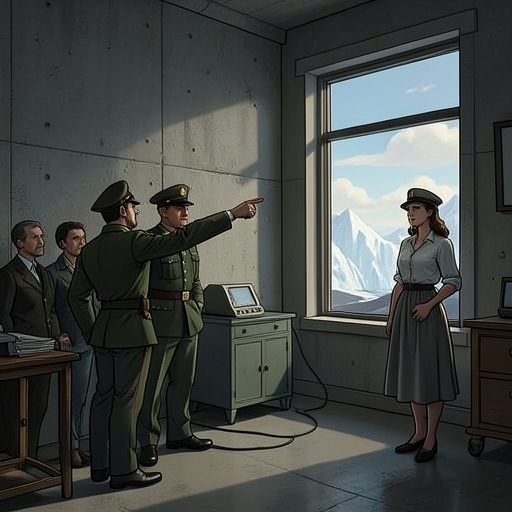
The flight log gives the secret meeting a ground-level, incomplete witness. After leaving Copenhagen, its writer met two unnamed intelligence officers in a park and was driven south in a military jeep to Flensburg. There, a German lieutenant and major joined the party alongside the Swedish count. The group travelled toward the front through refugee-clogged roads and bomb craters; in Schleswig-Holstein, the writer changed into a German uniform. They continued through Hamburg, where gasoline was waiting, and then followed the River Elbe to Berlin. The count’s papers, when shown at checkpoints, secured passage.
At the aerodrome, the writer waited outside a meeting attended by Nazi leaders and German generals, as well as one general from the Allied side. The count appeared to know his German companions already. Soldiers loaded two crates of gold bars and provisions onto the Junkers, painted in Allied camouflage. The flight log records the gold as cargo; Carr separately states that most of the gold under discussion had been taken from concentration camps. The meeting ran so long that the writer believed the aircraft would otherwise have escaped the approaching storm and ice. Afterward, the count and the Allied representative spoke by the plane about the Russians, the Ardennes, and Argentina, but the writer could not learn what had been negotiated.
The account’s immediate voice is confined to the trapped aircraft. In the cockpit, the writer records two kerosene lamps, the groaning fuselage, and two surviving Germans who blame him for the disaster. The metal box has gone with the count, handcuffed to his wrist. The writer wonders whether the count has the key, or whether the box contains something too important to abandon. He says that he had been trusted to keep a secret and needed to fly the plane across the Atlantic. These details make the flight log a record of both a covert mission and the writer’s helplessness after it: he can describe the route and cargo, but not the negotiations or the box’s contents.
Hitler, Napoleon, and the missing answer
Miller connected the operation’s name to Napoleon’s fate. In his account, Hitler was to be allowed to leave with his German shepherd, Blondi, and nothing else. Miller had long wondered whether the suggestion that Hitler’s life be spared arose from negotiations with the German war cabinet, whether Hitler was handed over to the Allies to facilitate talks, or whether the British and Americans were competing with the Russians to reach him first. He also considered the possibility that the Nazis hoped to divide the Allies, knowing Winston Churchill was no friend of the Russians. These remain alternatives Miller raises, not a settled explanation.
The historical analogy gives the codename its meaning. Miller says Napoleon was not aboard the plane, and explains that the operation was named for the fate of the earlier ruler. Yet when Kristín asks where Hitler is and whether the proposal was never carried through, the surviving account does not provide a definitive resolution. The name promises an explanation, while Miller’s recollection exposes how much even a former military commander does not know. Operation Napoleon therefore links a concrete flight and a lost cache of papers to a much larger uncertainty about what the Allies and Nazi leaders may have considered in the war’s final days.
The papers and the later cover story
The documents’ reappearance turns that uncertainty into a present danger. In the wreck, papers are found ruined by years of alternating heat and cold; the German typewriting is blurred, and attempts to separate the sheets make them fall apart. Kristín can nevertheless make out the words Operation Napoleon on one of the least damaged pieces. Another fragment, taken by Jón from the body of a German officer, remains with her in the pocket of her overalls. Six months after the traumatic events, she finds it again in a kitchen drawer and tries to decipher it under a bright light.
Kristín copies the surviving letters and words and asks a friend at the foreign ministry, a former diplomat in Germany, to translate them. She withholds both the document’s origin and its subject. The fragment describes a possible landing on a remote, uninhabited archipelago near Argentina, identifying Borne as a final option and referring to two other proposed locations. It stops before the plan can be reconstructed. Rather than solving the mystery, the translation gives Kristín another lead and renews the memories of the glacier, Steve, and Miller’s story. She keeps the notes and translation, tells neither Elías nor Júlíus, and locks the fragment away.
Meanwhile, American officials describe the wreck in terms designed to control access to it. They order a covert recovery, call for the aircraft and bodies to be transported to Keflavík, and instruct Ratoff to hand over any papers he finds. To pressure Icelandic authorities to remove their rescue team, a general claims that a German nuclear bomb lies on the glacier and calls it the first broken arrow. The warning is presented as a catastrophic risk requiring the Icelanders to withdraw. Another American officer later tells a flight lieutenant that there is no bomb and that the German aircraft is safe; Kristín, confronting the operation’s defenders, insists that the plane hides papers rather than a bomb, gold, or virus. The conflicting explanations show how claims of danger and secrecy serve the recovery effort, even as the documents themselves remain damaged and incomplete.
Operation Napoleon survives, then, neither as a complete file nor as an agreed account. It is pieced together from a pilot’s log, a British planning document, Miller’s qualified recollections, and scraps Kristín works to translate. The gold, the locked metal box, the false bomb story, and the papers recovered from the ice belong to different layers of the same episode, but they do not yield a final answer about what was decided. The glacier’s slow return of the aircraft makes that incompleteness consequential: each recovered fragment challenges official explanations without fully replacing them.